Baggage, Packing & What You Can Bring to the U.S.
Packing for a trip from Nigeria to the United States involves more than choosing what fits inside your suitcase. You need to understand your airline’s baggage allowance, airport security restrictions, and U.S. customs rules. This guide explains what belongs in your hand luggage, what to check before packing Nigerian food, how to handle medicines and electronics, and how to avoid expensive baggage mistakes before departure.

On this page
- Understanding the three baggage rule systems
- Airline baggage allowances and fees
- What to keep in your carry-on bag
- What belongs in checked baggage
- Liquids, electronics and power banks
- Taking Nigerian food into the U.S.
- Medicines and important documents
- A practical packing strategy
- Connecting flights and baggage collection
- Common baggage mistakes
- Useful packing and travel accessories
- Official sources
- Related travel guides
Understanding the three baggage rule systems
One of the most common mistakes international travelers make is assuming that an item is permitted simply because an airline allows it inside a suitcase. In reality, several different authorities may have rules about the same item.
For someone traveling from Nigeria to the United States, three checks are particularly important.
Airline baggage rules
Your airline determines how many bags you can check, their permitted dimensions and weight, and whether additional charges apply.
These rules depend on your ticket, airline and route.
Airport security rules
Airport security authorities determine what can pass through screening in your hand luggage or checked baggage.
Rules for liquids, sharp objects, batteries and certain electronics require particular attention.
U.S. customs and import rules
U.S. Customs and Border Protection and other federal agencies regulate what can enter the country.
Food, agricultural products, medicines and other restricted items may require declaration or special checks.
Important distinction
U.S. Transportation Security Administration (TSA) screening rules apply at U.S. airport checkpoints. When departing Nigeria or connecting through another country, you must also follow the security rules enforced at those airports. Do not assume that TSA guidance overrides the rules at your departure or transit airport.
For example, your airline may allow a food item inside checked baggage, but that does not automatically mean U.S. customs will permit the item into the country. Similarly, a power bank may fit within your baggage allowance but still be prohibited from checked luggage.
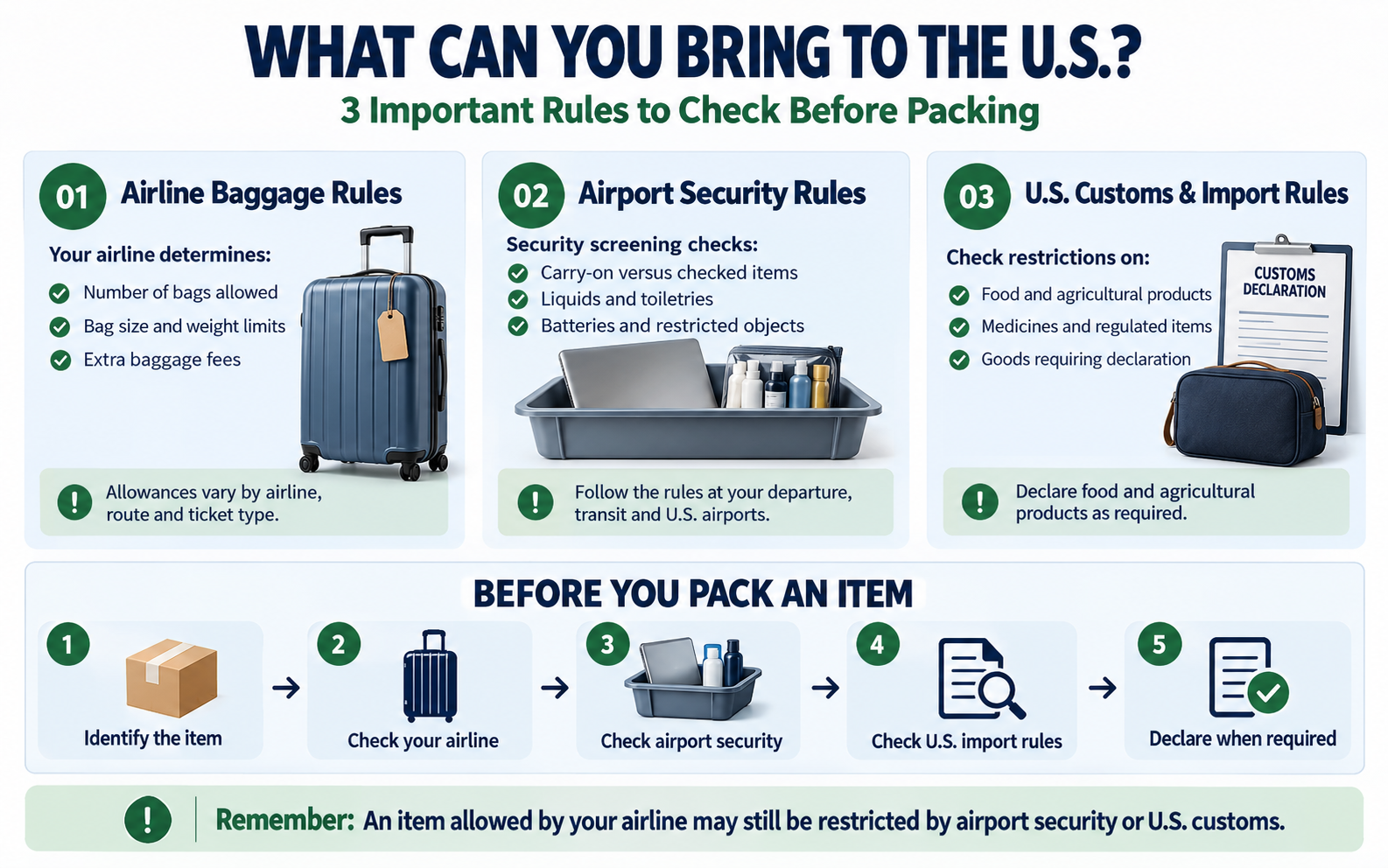
What Can You Bring to the U.S.? Three Rules to Check
Before packing for your journey from Nigeria to the United States, check three separate sets of requirements: your airline’s baggage allowance, the airport security rules along your route, and U.S. customs and import restrictions. This infographic explains how the rules work together.
Airline baggage allowances and fees
There is no single baggage allowance that applies to every flight from Nigeria to the United States. Your allowance depends on the airline, route, cabin class, fare type and sometimes the airlines operating different parts of your journey.
For example, two passengers flying from Lagos to New York may have different baggage allowances even when traveling on the same airline, because they purchased different ticket types.
What to check on your ticket
- Checked baggage allowance: The number of bags included and the weight permitted for each bag.
- Carry-on allowance: The number, size and weight of bags permitted in the aircraft cabin.
- Personal item: Whether a small backpack, handbag or laptop bag is allowed in addition to your carry-on.
- Excess baggage charges: What you will pay if your bags exceed the allowance.
- Connecting airlines: Whether different baggage rules apply to portions of your journey.
- Oversized baggage: Additional restrictions for large boxes, equipment or unusually shaped luggage.
Some international economy tickets include checked baggage, while others have more restrictive allowances. Never assume that every passenger is entitled to two checked bags of 23 kg each.
Practical advice
Check your actual booking confirmation before buying luggage or paying for additional bags. Weigh each suitcase at home and leave a small margin below the permitted weight. Airport scales may not give exactly the same reading as your home scale.
If you are still comparing flight options, read our Flights from Lagos guide for additional travel-planning information.
What to keep in your carry-on bag
Your carry-on bag should contain the things you may need during the journey and the items you cannot afford to lose if your checked luggage is delayed.
Think about what would happen if you arrived in the United States but your suitcase did not arrive until the following day. You should still be able to identify yourself, contact someone, take essential medication and reach your accommodation.
Your hand luggage checklist
- International passport and valid visa, where required.
- Flight itinerary and boarding passes.
- University admission and relevant immigration documents, if traveling to study.
- Accommodation address and contact information.
- Phone, laptop and other valuable electronics.
- Chargers, permitted power banks and essential accessories.
- Necessary medicines and supporting prescriptions.
- Wallet, payment cards and a reasonable amount of accessible money.
- One change of clothes and basic toiletries within applicable liquid limits.
- Emergency contact details saved offline.
Students should keep documents such as their Form I-20 and relevant SEVIS information accessible when applicable. Do not pack immigration documents inside checked baggage.
Remember
Your checked suitcase may be delayed, inspected or temporarily unavailable during the journey. Keep essential documents, medicines and valuables with you, subject to airline and security restrictions.
What belongs in checked baggage?
Checked baggage is generally the better place for clothing, shoes, larger permitted toiletries and other items you will not need during your flight.
However, checked baggage is not an unrestricted storage space. Dangerous goods, certain batteries, restricted products and other prohibited items may not be permitted.
Common checked-bag items
- Clothing and footwear
- Additional permitted toiletries
- Books and personal belongings
- Permitted household items
- Other non-essential belongings allowed by your airline and relevant authorities
Items requiring extra checks
- Power banks and spare lithium batteries
- Sharp objects and tools
- Flammable or hazardous products
- Food and agricultural products
- Restricted medicines
- Special equipment and oversized items
Do not place spare lithium batteries or power banks in checked baggage. They generally belong in carry-on baggage, subject to airline and aviation safety restrictions.
Label your suitcase with contact information and place a second contact note inside. Avoid displaying sensitive personal details unnecessarily on the outside of the bag.
Liquids, electronics and power banks
Airport security screening can be one of the most stressful parts of an international journey when your hand luggage contains liquids, batteries or electronic equipment that you have not checked beforehand.
Liquids and toiletries
At standard TSA checkpoints in the United States, the familiar 3-1-1 liquids rule generally permits containers of 3.4 ounces (100 ml) or less in a single quart-sized bag for carry-on baggage, with certain exceptions.
Medically necessary liquids and some other items may be treated differently. Screening rules at Nigerian and transit airports can also vary, so confirm the requirements that apply throughout your itinerary.
Larger toiletries are usually better packed in checked baggage if they are permitted and properly sealed.
Power banks and lithium batteries
Power banks and spare lithium batteries are generally required to travel in carry-on baggage rather than checked baggage. Battery capacity limits and airline approval requirements may apply.
Check the watt-hour rating of your power bank before departure. Do not assume that every high-capacity power bank is acceptable simply because it is sold commercially.
Laptops, phones and cameras
Keep valuable electronics in your carry-on when possible. Security officers may ask you to remove certain devices from your bag for screening, depending on the checkpoint procedures.
Battery safety
Never pack a damaged or recalled battery without checking the applicable restrictions. If your carry-on is taken at the gate for loading into the aircraft hold, remove power banks and spare lithium batteries and keep them with you in the cabin.
Taking Nigerian food into the United States
Many Nigerians traveling abroad want to carry familiar foods, especially when relocating for school, work or family reasons. Items such as garri, egusi, ogbono, dried pepper, seasoning ingredients, dried fish and other traditional food products may be considered for packing.
However, whether a particular item is allowed depends on its ingredients, processing, country of origin and applicable U.S. import restrictions. There is no reliable rule that says every dried or packaged Nigerian food item is automatically permitted.
Food items that need careful checking
- Meat and meat products: These can face significant restrictions, including products that have been dried, cooked or processed.
- Fresh fruits and vegetables: Many are restricted because they may carry agricultural pests or diseases.
- Seeds and planting materials: Special restrictions or permits may apply.
- Dried fish and seafood: Requirements can depend on the species, preparation and other import rules.
- Grains, beans and dried ingredients: Their admissibility depends on the particular product and applicable agricultural restrictions.
- Homemade or unlabelled food: These may be harder for officers to identify and assess.
What about garri, egusi and ogbono?
Do not rely on social media claims that these foods are always allowed or always prohibited. Check the current guidance for the specific item, including whether it is processed for consumption or capable of planting.
For example, seeds intended for planting may be regulated differently from processed food ingredients. The way an item is prepared and packaged can matter, but packaging alone does not guarantee admission.
When carrying food or agricultural products, declare them to U.S. Customs and Border Protection as required. A declaration allows the relevant officials to inspect the items and determine whether they can enter.
Important for Nigerian travelers
Do not conceal food items because someone told you that customs officers will confiscate them. Declare agricultural and food products truthfully. Proper declaration is important even when an item is ultimately not admitted.
For additional information, consult the USDA APHIS guidance on traveling with agricultural products and the official CBP guidance before packing.
Medicines, prescriptions and important documents
If you take medication regularly, prepare for your journey before departure rather than assuming you can immediately obtain the same medicine after arriving in the United States.
Medicines available over the counter in Nigeria may be regulated differently in the United States. Some prescription medicines, controlled substances and products containing particular ingredients may face additional restrictions.
Before packing medication
- Check whether the medication is permitted under applicable U.S. rules.
- Keep medicines in clearly identifiable packaging where practical.
- Carry your prescription or a doctor’s letter when appropriate.
- Keep essential medication accessible during the journey.
- Check additional rules for controlled substances, syringes and medical equipment.
- Avoid carrying unusually large quantities without checking the relevant requirements.
For U.S. medication import guidance, consult the Food and Drug Administration’s personal importation information.
Keep important documents separate from checked luggage
Carry your passport, visa, admission or employment documents, relevant travel confirmations and emergency contacts in a secure location that you can access when needed.
Save digital copies of important documents in secure storage, but do not rely exclusively on internet access after landing.
A practical packing strategy before leaving Nigeria
Good packing is not about filling every available space. It is about knowing what you need immediately, what can safely travel in checked baggage, and what may be easier to purchase after arrival.
A few days before your flight
- Confirm the baggage allowance shown on your booking.
- Check your airline’s latest prohibited-items and battery policies.
- Review U.S. restrictions for any food, agricultural products or medication you intend to carry.
- Prepare your travel documents and emergency contacts.
- Make a simple list of what goes into each suitcase.
- Check the weather at your destination so you pack suitable clothing.
The day before departure
- Weigh every checked bag and your carry-on if the airline applies a weight limit.
- Check that your luggage closes securely without forcing the zips.
- Separate important documents and essential medication.
- Charge your phone and permitted power bank.
- Save your accommodation address and transport arrangements offline.
- Keep fragile items protected and avoid packing valuables in checked baggage.
Your arrival essentials
Passport, documents, phone, medication, payment method, charger, contact information and a change of clothes.
Your checked luggage
Clothing, footwear, permitted toiletries, books and other non-essential belongings within the airline’s allowance.
Items to verify first
Food, batteries, unusual electronics, medical supplies, tools, sharp objects and anything potentially restricted.
Our Before Leaving Nigeria guide covers additional departure preparation, including documents, financial arrangements and important tasks to complete before traveling.
Connecting flights and baggage collection
Many travelers flying from Nigeria to the United States connect through another airport before reaching their final destination. Depending on your itinerary, you may travel through Europe, the Middle East, Africa or another U.S. airport.
Do not assume that your checked baggage will always move automatically to your final destination without your involvement.
When your first U.S. airport is not your final destination
When entering the United States, international passengers commonly complete immigration and customs procedures at their first U.S. port of entry. Depending on the airport and itinerary, they may need to collect checked baggage, complete customs procedures and recheck the bags for an onward domestic flight.
Some airports and itineraries have different baggage-handling arrangements, so follow the instructions from your airline and airport staff.
What to confirm before travel
- Whether your bags are checked through to your final destination.
- Whether you must collect and recheck baggage during a connection.
- Whether you need to change terminals or airports.
- Whether your connection allows enough time for immigration, customs and security.
- Whether the next airline has different baggage rules.
For a more detailed explanation, read our Connecting Flight After U.S. Entry guide.
Common baggage and packing mistakes to avoid
- Assuming every airline offers the same allowance: Check the baggage conditions attached to your actual ticket.
- Packing food without checking import rules: Some Nigerian food products may be restricted even when properly packaged.
- Failing to declare agricultural items: Declare relevant items truthfully when entering the United States.
- Putting important documents in checked luggage: Keep passports, visas and essential records accessible.
- Putting power banks in checked bags: Follow aviation battery rules and keep spare lithium batteries in the cabin as required.
- Overpacking: Leave some weight margin and consider whether certain items can be purchased after arrival.
- Ignoring connecting-flight arrangements: Confirm whether baggage collection and rechecking are necessary.
- Carrying unidentified medicines: Check U.S. requirements and keep supporting information where appropriate.
- Leaving valuables unprotected: Keep important electronics, jewellery and other valuable items with you when permitted.
Final packing check
Before leaving for the airport, confirm three things: your bags meet the airline’s allowance, their contents comply with the relevant security rules, and anything you intend to bring into the United States meets applicable import and declaration requirements.
Some product links on this page may be affiliate links. If you purchase through an affiliate link, NigeriaToUSA may earn a commission at no additional cost to you.
Official sources and current travel rules
Baggage allowances, airport screening procedures and import restrictions can change. Always verify the current rules before departure, especially when carrying food, medication, batteries or unusual equipment.
- Transportation Security Administration — What Can I Bring?
- TSA — Liquids Rule
- Federal Aviation Administration — PackSafe
- USDA APHIS — Traveling with Agricultural Products
- U.S. Customs and Border Protection — Prohibited and Restricted Items
- U.S. Food and Drug Administration — Personal Importation
- Your operating airline’s official baggage allowance and restricted-items information.
- Security guidance from your departure and transit airports.
Important note
This guide provides general travel information and does not replace instructions from airlines, airport security authorities, customs officers or other relevant government agencies. The rules applicable to your specific itinerary and items take priority.