U.S. Customs Declaration: What Nigerian Travellers Need to Know
Arriving in the United States with food, gifts, medication or money? This guide explains what to tell U.S. Customs and Border Protection (CBP), what may be inspected, and how to prepare before flying from Nigeria. Declaring an item does not automatically mean it is prohibited. See also our Baggage & Packing guide and Airport Arrival guide.
On this page
- What a customs declaration means
- Before leaving Nigeria
- Food, plants and Nigerian ingredients
- Cash and monetary instruments
- Medication and health products
- Gifts, purchases and commercial goods
- What happens at customs inspection
- Common mistakes to avoid
- Quick declaration checklist
- Official sources
- Related guides
What a U.S. customs declaration means
A customs declaration is how you tell CBP about items you are bringing into the country that must be reported. Depending on the airport and your eligibility, you may answer questions directly to an officer or through an approved electronic or written process. Do not assume every traveller will receive a paper form.
A truthful declaration helps officers decide whether an item is allowed, needs inspection, is subject to duty or must be surrendered. Even packaged, cooked or familiar items may be restricted.
The central rule
If you are unsure whether food, a plant or animal product, medication or another item needs to be declared, tell the CBP officer and describe it accurately. Do not hide it or guess.
Before leaving Nigeria
Make a short inventory of any food, herbal products, medication, gifts, purchases or large amounts of currency you plan to carry. Check the specific item against current U.S. agency guidance before packing.
- Keep food in identifiable packaging with ingredient labels and country-of-origin information when available.
- Carry prescriptions or a doctor’s letter in English for medications, especially unfamiliar or controlled medicines.
- Keep receipts for valuable gifts and purchases, and know their approximate value.
- Check your combined family or group currency amount before travelling.
- Separate items you may need to present for inspection so you can find them quickly.
Airline baggage rules, TSA security screening and U.S. customs/agricultural entry restrictions are different requirements. Read Baggage, Packing & What You Can Bring to the U.S. for the broader packing picture.
U.S. Customs Declaration: What Nigerian Travellers Must Declare
Use this visual checklist to understand the main categories of items you may need to declare when entering the United States. It covers food and agricultural products, cash and monetary instruments, medication, gifts and purchases, commercial goods, and restricted items. Declaring an item does not guarantee it will be allowed into the country.
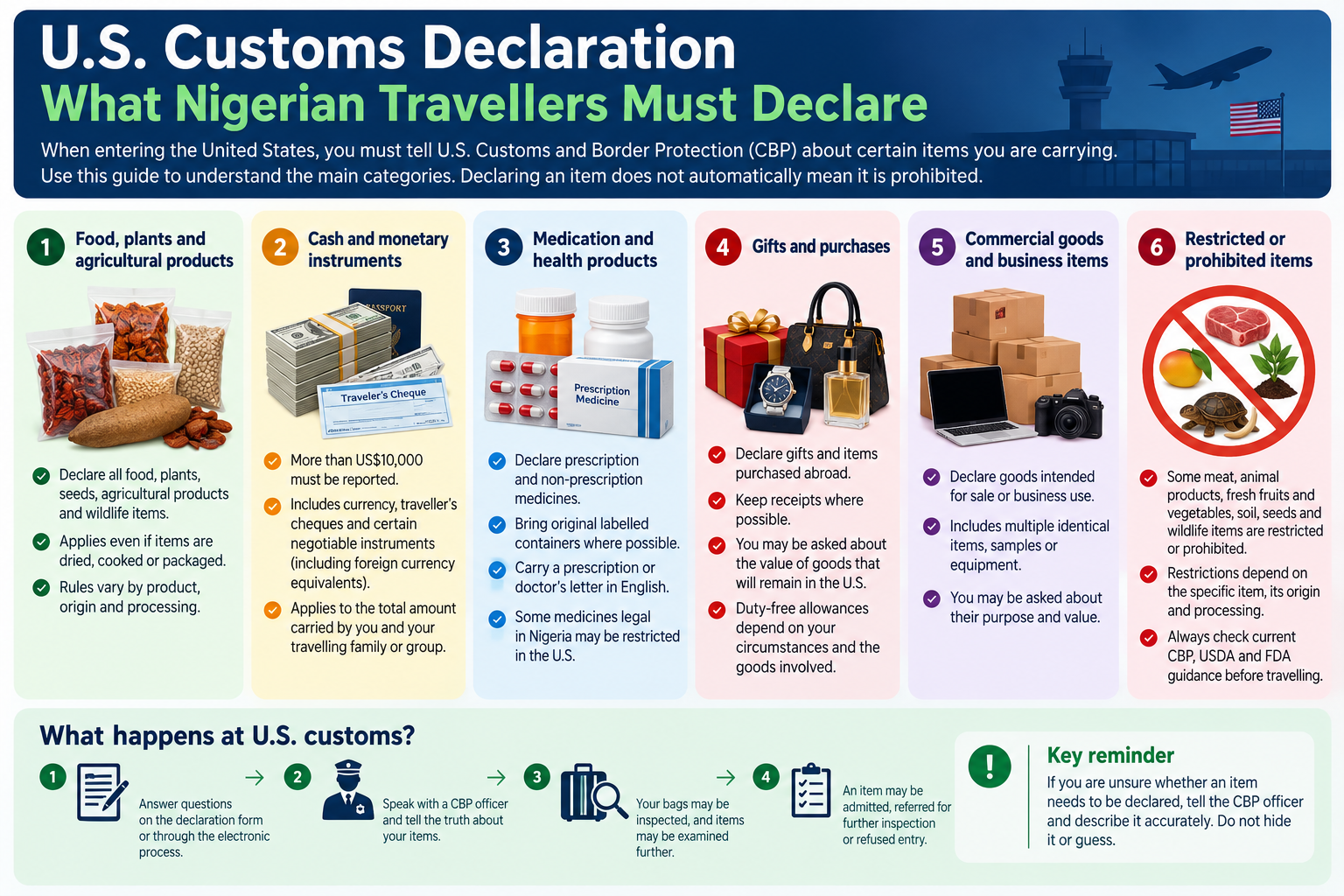
Click the infographic to open the full-size version for viewing, downloading, or printing.
Food, plants and Nigerian ingredients
Declare all food, plants, agricultural products and wildlife items to CBP. This applies even when items are dried, cooked, commercially packaged or intended as gifts. USDA APHIS and CBP determine admissibility based on the specific product, its origin and processing.
For example, if you plan to travel with dried fish, crayfish, egusi, ogbono, dried pepper, beans, herbs, seeds or other Nigerian ingredients, do not assume that a friend’s previous experience proves yours will be allowed. Identify the ingredients accurately and check the applicable USDA requirements. Meat and animal products, fresh fruits and vegetables, soil and certain seeds deserve particular caution.
APHIS explains that travellers who properly declare agricultural products generally do not face penalties merely because an inspector decides the products cannot enter; however, the item may still be refused or surrendered. Failure to declare can lead to penalties.
Practical example
If an officer asks whether you have food and you are carrying a sealed bag of Nigerian ingredients, answer yes and explain exactly what is inside. “It is packaged” is not a substitute for declaration.
Cash and monetary instruments over $10,000
You may legally carry any amount of money into or out of the United States, but more than US$10,000 in currency or covered monetary instruments (including foreign-currency equivalents) must be reported. The rule also covers certain traveller’s cheques and negotiable instruments, not just physical U.S. dollars.
CBP states that when families or groups travel together, the threshold applies to the total they carry collectively. Do not split money between travellers or bags to avoid reporting. Reportable amounts require FinCEN Form 105, which can be filed electronically.
For ordinary finances after arrival, consult Money & Banking in the U.S..
Important distinction
Reporting more than $10,000 is not the same as paying a tax for carrying it. Failure to report correctly, however, can have serious consequences.
Medicines, prescriptions and health-related items
Declare medications and medicinal products as required by CBP. For personal-use medicines, bring the original labelled containers where possible and a prescription or doctor’s note in English. CBP and FDA guidance commonly refers to a 90-day supply as a rule of thumb for temporary visitors, not a blanket guarantee that every medicine or quantity is permitted.
Some medicines legally sold in Nigeria may be restricted or unapproved in the United States. Controlled substances may also be subject to DEA requirements. Check the specific medicine with the FDA and CBP before travelling; never assume a Nigerian prescription automatically makes an item admissible.
If you cannot carry the original packaging, CBP advises bringing supporting prescription documentation or a physician’s letter explaining the medication.
Gifts, purchases and commercial goods
CBP may ask about goods purchased abroad, gifts you are bringing for other people, and merchandise intended for sale or business use. The customs declaration form distinguishes personal effects from commercial merchandise and asks about the value of goods that will remain in the United States.
Keep purchase receipts where practical. If you are carrying multiple identical items for resale, samples for business or expensive gifts, describe their purpose truthfully. Duty-free allowances and exemptions depend on your circumstances and the goods involved; do not assume every gift is automatically exempt.
What happens at U.S. customs inspection
After arriving at your first U.S. airport, follow the instructions for immigration, baggage collection and customs. Procedures differ by airport and by whether your itinerary uses a preclearance location. A CBP officer may ask what you are carrying, request receipts or documents, inspect your luggage or refer you for further inspection.
- Answer questions calmly and accurately.
- Identify and present declared items if asked.
- Follow instructions if an item is referred for agricultural or other inspection.
- Understand that an item may be admitted, examined further or refused entry.
- Allow enough connection time when your first U.S. airport requires immigration, baggage collection, customs and security screening.
For onward domestic travel, see Connecting Flights After U.S. Entry.
Common customs declaration mistakes
- Assuming sealed, dried or cooked food never needs declaration.
- Relying on another traveller’s social-media experience rather than current item-specific guidance.
- Confusing what an airline permits in baggage with what CBP or USDA permits into the country.
- Treating the $10,000 reporting threshold as a per-person loophole for travelling families or groups.
- Carrying medicines without useful identifying or prescription documents.
- Forgetting gifts, commercial merchandise or purchases when answering declaration questions.
- Hiding an item because you worry an officer may confiscate it.
If in doubt
Declare the item and ask the officer. Accurate disclosure is safer than making assumptions.
Quick declaration checklist before landing
- Do I have any food, herbs, seeds, plants, animal products or wildlife items?
- Do I have medication or health products requiring documentation?
- Am I or my travelling family/group carrying more than US$10,000 in reportable currency or monetary instruments?
- Do I have gifts, purchases or commercial merchandise to report?
- Can I describe the contents and value of the items accurately?
- Have I checked current official guidance for anything unusual or restricted?
Keep your answers truthful even if you are not handed a paper declaration form. This checklist is preparation, not a replacement for official CBP instructions.
Official sources to verify
Entry rules and procedures can change. These are official starting points for checking your specific items before travel:
- CBP — What items must I declare?
- CBP — Sample Customs Declaration Form 6059B (PDF)
- USDA APHIS — Travelling with food and agricultural products
- USDA APHIS — Fruits and vegetables
- CBP — Currency and monetary instruments reporting
- CBP — Travelling with medication
- FDA — Human drug imports and personal importation
Editorial note
This guide is general educational information. CBP and other responsible U.S. agencies make the final decisions about entry and admissibility.