Housing & Renting in the U.S.: A Practical Guide for Nigerian Newcomers
Finding a safe, affordable place to live is an important part of relocating from Nigeria to the United States. This guide explains rental options, housing budgets, apartment applications, credit checks, security deposits, leases, tenant rights, and how to avoid rental scams.
Renting in the United States may feel unfamiliar because landlords often use screening procedures involving income, credit history, identification, and previous rental records. Having no U.S. credit history does not automatically prevent you from renting, but it may affect the documents you need to provide.
Whether you are moving for work, education, or family reasons, understanding the rental process can help you make informed decisions before committing your money.

On this page
- Understanding the U.S. rental process
- Types of housing available
- Planning your rental budget
- Where to search for housing
- Rental applications and required documents
- Renting without U.S. credit history
- How to avoid rental scams
- Understanding lease agreements
- Tenant rights and responsibilities
- Preparing to move into your rental
- Rental checklist for newcomers
- Common renting mistakes
- Frequently asked questions
- Housing and renting services
- Official sources
- Related guides
Understanding the U.S. rental process
Rental properties in the United States are offered by individual landlords, property management companies, and apartment communities. Each may have different application requirements, fees, lease terms, and screening procedures.
Although the process varies by location, most renters follow a similar sequence.
Typical steps to renting a home
- Determine your budget: Calculate how much you can comfortably spend on rent, utilities, transportation, and other expenses.
- Search for suitable housing: Compare properties based on location, price, size, and availability.
- Verify the property: Confirm that the listing is genuine and the person advertising it is authorized to rent it.
- Review application requirements: Ask about income, identification, credit checks, and supporting documents.
- Submit an application: Apply through the landlord’s or property manager’s verified process.
- Review and sign the lease: Understand the terms before agreeing.
- Make required payments: Follow verified payment instructions and retain receipts.
- Inspect the property: Document its condition when you move in.
Practical tip
You do not have to secure a long-term apartment before arriving in the United States. Verified temporary accommodation may allow you to inspect properties, compare neighborhoods, and understand local rental requirements before committing to a lease.
Types of housing available in the United States
The right housing option depends on your household size, budget, destination, privacy preferences, and expected length of stay.
Self-contained units in residential buildings or apartment communities. Some offer laundry facilities, parking, maintenance, and shared amenities.
Smaller units with combined living and sleeping areas. They may be suitable for individuals or couples seeking a compact home.
Renting a room or sharing an apartment with roommates can reduce housing expenses, especially for students and single newcomers.
Properties that may offer additional bedrooms, storage, and living space for families. Maintenance obligations depend on the lease.
Accommodation offered or arranged by universities, including residence halls and, at some institutions, graduate or family housing.
Short-term furnished rentals, extended-stay properties, or other verified options while searching for permanent housing.
Before choosing a property, confirm whether it is furnished, which utilities are included, the lease duration, and any lawful occupancy restrictions.
Planning your rental budget
Monthly rent is only one part of your housing expenses. Before applying for an apartment, calculate the total amount you may need both upfront and every month.
Housing costs vary significantly between cities, neighborhoods, and property types. A property with lower advertised rent may cost more overall if transportation, utilities, and additional charges are high.
Common housing expenses
| Expense | What it covers |
|---|---|
| Monthly rent | The regular payment required under your lease. |
| Security deposit | An upfront deposit that may be refundable, subject to lawful deductions. |
| Application fee | A charge for processing an application or screening, where permitted. |
| Electricity and gas | Power, heating, cooking, and other energy costs not included in rent. |
| Water and other utilities | Charges for services not covered by the landlord. |
| Internet | Home internet service and related equipment charges. |
| Renter’s insurance | Insurance that may be required by the lease or useful for personal protection. |
| Parking and transport | Parking fees, public transportation, fuel, and commuting expenses. |
| Moving expenses | Furniture, bedding, household supplies, and transportation. |
Example of upfront rental expenses
Imagine you find an apartment advertised at $1,500 per month. The landlord requires the first month’s rent, a security deposit equal to one month’s rent, and an application fee of $50.
$1,500
$1,500
$50
Illustrative upfront total: $3,050.
This is an example for budgeting purposes, not a current rental price quotation. Actual deposit limits, fees, and payment requirements depend on the property and applicable laws.
Budgeting tip
Compare housing and transportation costs together. A lower-rent apartment far from work or school may become more expensive after commuting expenses are included.
Where to search for housing in the U.S.
Rental properties may be advertised through apartment-search websites, property management companies, real estate agents, university housing offices, and community networks.
Popular rental-search platforms
Browse rental listings, compare locations, and review advertised property information.
Search apartment communities and other rental properties across different locations.
These platforms are examples, not guarantees that every listing is legitimate. Independently verify the property and the person authorized to rent it.
What to consider when choosing a neighborhood
- Distance to your workplace or university
- Access to buses, trains, or other transportation
- Nearby supermarkets, pharmacies, and healthcare facilities
- Availability and cost of parking
- Building condition and maintenance arrangements
- Schools and childcare options where relevant
- Heating, cooling, and utility expenses
- Local services and everyday convenience
Important note
A virtual tour can help you review a property from Nigeria, but it does not establish that the advertiser is legitimate. Confirm the identity and authority of the landlord or property manager independently.
Rental applications and required documents
Landlords may request information to verify your identity, assess your ability to pay rent, and review previous rental history. Requirements vary by property, management company, and applicable law.
Documents you may be asked to provide
- Passport or accepted identification: To verify your identity.
- Employment letter: To confirm your job or expected employment income.
- Recent payslips: If you are already employed.
- Bank statements: Where accepted as evidence of financial resources.
- Rental references: Information from previous landlords.
- Student funding documents: Where accepted for student applicants.
- Guarantor information: If a qualified co-signer is required.
- Screening authorization: Consent for permitted credit or tenant screening.
What is tenant screening?
Tenant screening is the process some landlords use to assess applicants. It may involve a credit report, rental history, background information, or other lawful checks.
Where a consumer report is used and an adverse decision is based on that report, federal consumer-reporting law may require a notice and provide rights to obtain and dispute information in the report.
Learn more from the Consumer Financial Protection Bureau’s consumer reporting resources.
Protect your information
Do not send passport scans, bank statements, Social Security numbers, or other sensitive documents to an unverified advertiser. Confirm the application process before sharing personal information.
Renting without U.S. credit history
New arrivals from Nigeria may not yet have a U.S. credit report or credit score. This can make some rental applications more complicated, but it does not automatically prevent you from qualifying for housing.
Some landlords accept alternative documents or arrangements, depending on their policies and applicable law.
Possible alternatives to ask about
A verified offer showing your expected income and employment start date.
Financial documents showing available funds, where accepted.
A qualified person who accepts certain financial responsibilities under the agreement.
References from earlier landlords, including overseas references if accepted.
Some landlords may discuss alternative deposits or advance payment arrangements. However, these must comply with applicable state and local laws. Never assume that paying several months upfront is allowed or guarantees approval.
Practical tip
Before paying an application fee, ask whether the property accepts applicants without U.S. credit history and which alternative documents may be considered.
For information about establishing and managing your finances, read our Money & Banking in the U.S. guide.
How to avoid rental scams in the United States
Rental scams can be particularly difficult to detect when you are searching from outside the United States. Scammers may copy legitimate photographs, impersonate landlords, advertise unavailable properties, or demand payment before you can verify a listing.
Common rental scam warning signs
- The advertised rent is unusually low compared with similar properties.
- The advertiser refuses reasonable property viewing or verification requests.
- You are pressured to transfer money immediately.
- The person collecting money cannot establish authority to rent the property.
- The listing information conflicts with other sources.
- You are asked to pay through gift cards, cryptocurrency, or other difficult-to-recover methods.
- You are asked for sensitive personal documents before the provider is verified.
How to verify a rental listing
- Search for the property address independently.
- Compare the listing against other reliable property information.
- Find the management company’s official contact details separately.
- Confirm that the person communicating with you is authorized to rent the property.
- Ask about viewings, screening requirements, fees, and deposits.
- Read written terms before sending payment.
- Retain receipts and records of communication.
Security warning
Do not let pressure to secure an apartment replace proper verification. Before sending money, confirm what the payment is for, whether it is refundable, who receives it, and which written document explains it.
For additional guidance, review the Federal Trade Commission’s rental listing scam advice.
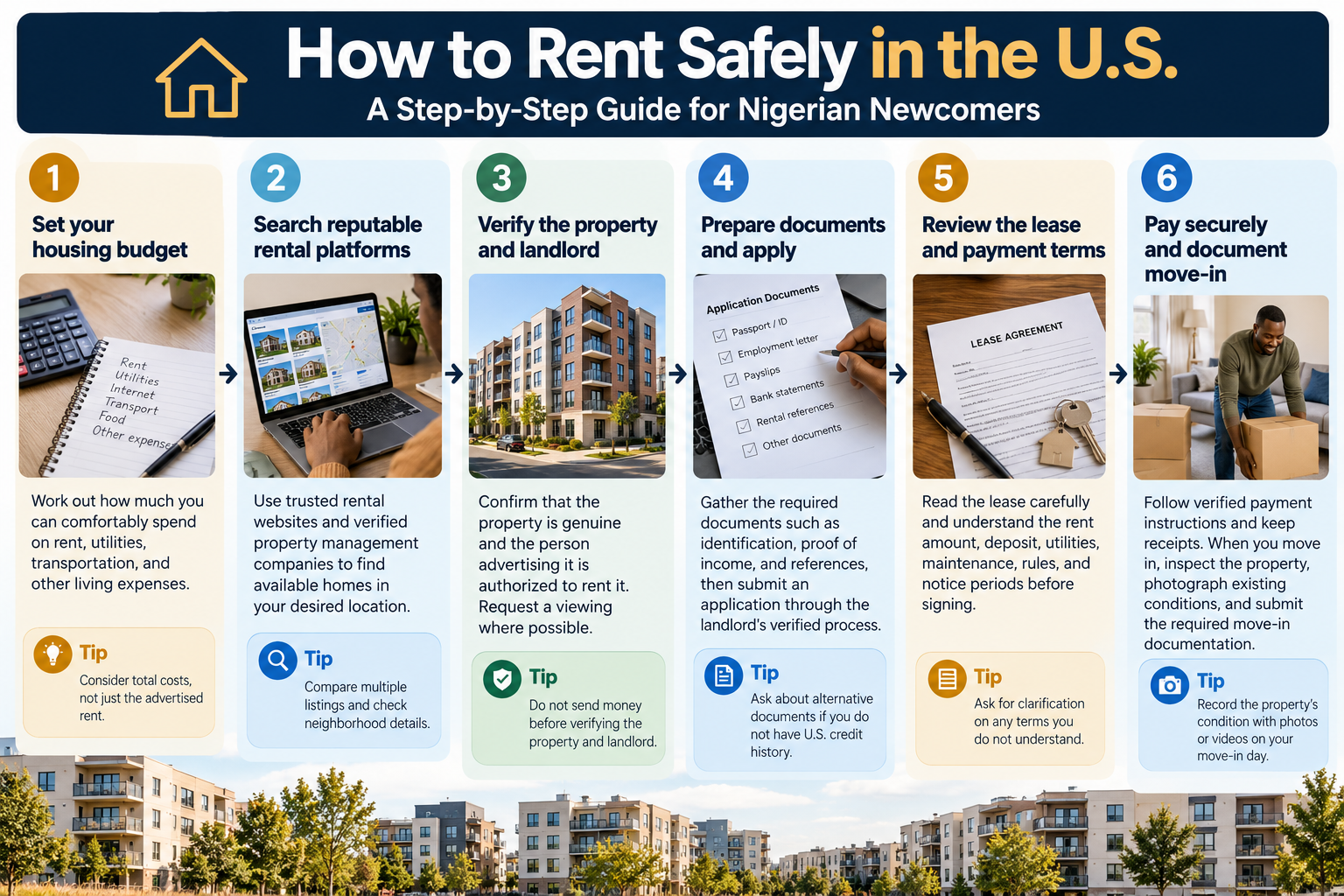
Infographic: How to Rent Safely in the U.S.
Follow these six practical steps to search for accommodation, avoid rental scams, understand lease agreements, and move into your new home safely.
Understanding rental lease agreements
A lease is a legal agreement between a landlord and tenant. It sets out the terms under which you may occupy the property and the responsibilities of both parties.
Read the lease carefully before signing or making substantial payments. Ask for clarification in writing when a provision is unclear.
Important lease terms to review
| Lease term | What to check |
|---|---|
| Rent amount | Monthly rent, due date, and accepted payment methods. |
| Lease duration | Start date, end date, and renewal arrangements. |
| Security deposit | Amount, deductions, and return procedures. |
| Utilities | Which services are included and which you must arrange. |
| Maintenance | Repair reporting procedures and responsibilities. |
| Late fees | Charges for overdue rent, subject to applicable law. |
| Guests and occupancy | Lawful rules governing residents and visitors. |
| Parking and pets | Restrictions, permissions, and additional charges. |
| Ending the lease | Notice requirements and potential early termination obligations. |
Fixed-term and month-to-month rentals
Runs for an agreed period, often 12 months. Ending it early may create obligations depending on the agreement and applicable law.
Continues on a monthly basis. Notice requirements and rent-change rules vary by location and agreement.
Practical tip
Keep copies of your signed lease, payment receipts, inspection reports, and important messages. Written records can help if a disagreement arises later.
Tenant rights and responsibilities
Landlord-tenant laws vary across U.S. states and cities. Local rules may govern deposits, repairs, notice periods, rent increases, habitability, and eviction procedures.
Fair housing protections
The federal Fair Housing Act prohibits certain housing discrimination based on race, color, religion, sex, national origin, familial status, and disability. State and local laws may provide additional protections.
A housing provider cannot lawfully discriminate against you because of your Nigerian national origin. However, landlords may apply lawful and nondiscriminatory rental qualification standards.
For more information, visit the U.S. Department of Justice’s Fair Housing Act resources.
Common tenant responsibilities
- Pay rent according to the lease and applicable law.
- Follow lawful property and occupancy rules.
- Maintain reasonable cleanliness and avoid preventable damage.
- Report maintenance issues promptly.
- Provide required notices when ending a tenancy.
- Respect other residents and shared facilities.
Important note
There is no single rental law that applies identically throughout the United States. Always check the rules for your destination state and city.
Preparing to move into your rental
Once your application is approved and your lease is signed, complete the practical steps necessary to move in safely and keep accurate records.
Move-in preparation steps
- Confirm the move-in date: Make sure the property will be available as agreed.
- Arrange utilities: Confirm which services must be activated in your name.
- Check insurance requirements: Obtain renter’s insurance if required or appropriate.
- Inspect the property: Look for existing damage or maintenance problems.
- Take photographs or videos: Record the condition of walls, floors, appliances, windows, and fixtures.
- Submit the inspection report: Follow the property’s move-in documentation process.
- Confirm access: Collect keys, access codes, and parking instructions.
- Save maintenance contacts: Know how to report routine and emergency problems.
Move-in tip
Document existing damage immediately and report it through the property’s required process. Keep dated copies of photographs, inspection reports, and messages.
Rental checklist for Nigerian newcomers
Use this checklist to organize your housing search, application, and move-in process.
- ☐ Calculate your total housing budget
- ☐ Check the location and commute
- ☐ Verify the property and landlord
- ☐ Confirm screening requirements
- ☐ Prepare accepted documents
- ☐ Understand application fees
- ☐ Read the complete lease
- ☐ Confirm security deposit rules
- ☐ Check utilities and extra charges
- ☐ Understand renewal and notice terms
- ☐ Verify payment instructions
- ☐ Save signed copies and receipts
- ☐ Confirm your move-in date
- ☐ Arrange required utilities
- ☐ Check insurance requirements
- ☐ Photograph existing damage
- ☐ Submit the inspection checklist
- ☐ Save maintenance contact details
Common renting mistakes to avoid
- Paying before verifying a property: Do not transfer money simply because an advertiser claims other applicants are waiting.
- Ignoring additional costs: Include utilities, deposits, transport, insurance, and moving expenses.
- Assuming no credit history means no options: Ask whether alternative documents are accepted.
- Signing without reading the lease: Review renewal, termination, maintenance, and deposit terms.
- Overlooking commuting costs: Consider distance and transportation availability before choosing a property.
- Sharing documents too early: Verify the rental provider before sending sensitive information.
- Failing to document move-in conditions: Record existing damage and report problems promptly.
- Assuming laws are the same everywhere: Check the relevant state and local requirements.
Before making a payment
Ask what you are paying for, whether the payment is refundable, who receives it, and which written document explains it. Verify the arrangement if any answer is unclear.
Frequently asked questions about renting in the U.S.
Can I rent an apartment before arriving in the United States?
Some landlords accept remote applications and electronic lease signing. However, verify the property, management company, and payment instructions independently. If you cannot confidently assess a long-term rental from Nigeria, verified temporary accommodation may be a safer starting point.
Do I need a Social Security number to rent an apartment?
Not every landlord uses the same screening process. Some request a Social Security number, while others may accept alternative identification or verification methods. Ask the property manager about their requirements before applying.
Can international students rent private apartments?
Yes. International students may qualify for private rentals or university housing, subject to the provider’s requirements. Some landlords accept enrollment documents, funding evidence, guarantors, or other approved alternatives.
Is a security deposit refundable?
A security deposit may be refundable, subject to lawful deductions. Deposit limits, handling rules, and return deadlines depend on state and local law. Keep your lease, receipts, and move-in inspection records.
Is renter’s insurance compulsory?
Some landlords require renter’s insurance under the lease. Even when optional, a suitable policy may provide coverage for certain personal property losses and liability. Review the terms, limits, and exclusions before purchasing.
Can a landlord refuse to rent to me because I am Nigerian?
Federal fair housing law prohibits housing discrimination based on national origin. A landlord may apply lawful, nondiscriminatory qualification standards, but discrimination because of your Nigerian national origin is not permitted.
Affiliate placeholder: housing and renting services in the U.S.
Recommended services to help newcomers search for rental accommodation, compare renter’s insurance options, and prepare for moving into a new home.
Official and reliable sources
Housing laws, screening procedures, tenant protections, and deposit requirements vary by location. Use official sources and check the landlord-tenant rules for your destination state and city.
- Federal Trade Commission — Rental Listing Scams
- Consumer Financial Protection Bureau — Consumer Reporting Companies
- U.S. Department of Justice – Fair Housing Act
- USA.gov — Housing Help
Important note
This page provides general educational information, not individualized legal or financial advice. Verify current rules in the state and city where you intend to rent.