Money & Banking in the U.S.: A Practical Guide for Nigerian Newcomers
Understanding money and banking in the United States is an important part of settling in. Whether you are arriving for work, study, or family relocation, you will need to understand how U.S. bank accounts, debit cards, credit cards, transfers, bills, and credit history work. This guide explains the basics, common mistakes, and practical steps to help Nigerians manage their finances more confidently after arrival.
On this page
- Understanding the U.S. banking system
- Preparing your money before leaving Nigeria
- Opening a U.S. bank account
- Checking and savings accounts
- Banks, credit unions, and deposit insurance
- Debit cards versus credit cards
- Routing numbers, ACH, and money transfers
- Checks, direct deposits, and bill payments
- Understanding U.S. credit history
- Bank fees and everyday budgeting
- Banking security and scams
- Common mistakes to avoid
- Helpful banking and money-management tools
- Official sources
- Related guides
Understanding the U.S. banking system
The U.S. financial system becomes easier to understand when you separate three important ideas: where your money is stored, how you make payments, and how borrowing affects your credit history.
Checking and savings accounts hold your money. They are generally used for everyday spending, receiving payments, and keeping money aside.
Debit cards, bank transfers, checks, and payment apps allow you to move money or pay for goods and services.
Credit cards and loans allow you to borrow money. How you manage eligible credit accounts can affect your U.S. credit history.
Unlike everyday banking arrangements you may be familiar with in Nigeria, U.S. banking also involves systems such as routing numbers, ACH transfers, credit reports, overdraft settings, and different forms of deposit insurance.
Practical framing
You do not need to understand every U.S. financial product immediately. Start with a safe way to access your money, learn how payments work, and avoid unnecessary borrowing or fees while you settle in.
Preparing your money before leaving Nigeria
Financial preparation should begin before your flight. You may not be able to open a suitable U.S. bank account immediately after landing, and some Nigerian payment cards may not work for every U.S. transaction.
Pre-travel financial checklist
- Notify your bank if appropriate: Ask whether international transactions are enabled and whether a travel notification is necessary.
- Check card acceptance: Confirm your debit or credit card’s international transaction limits, supported currencies, and applicable fees.
- Plan your first expenses: Budget for airport transportation, accommodation, meals, phone service, and emergencies.
- Arrange more than one payment method: Consider a suitable international card and a reasonable amount of U.S. cash for initial expenses.
- Check transfer arrangements: Understand how you can legally access or transfer your funds after arrival.
- Save important banking contacts: Keep your bank’s official customer-support and card-blocking information accessible.
- Protect account access: Update recovery options and ensure you can receive security alerts while abroad.
- Keep financial documents available: Depending on your situation, you may need proof of funds, sponsorship records, or transaction documentation.
Review the Before Leaving Nigeria guide alongside this checklist.
Important travel rule
If you are entering or leaving the United States with more than US$10,000 in currency or monetary instruments in aggregate, U.S. reporting requirements generally apply. This is a reporting requirement, not a general prohibition on carrying more than US$10,000. Family or group rules can also matter. Check the current CBP and FinCEN requirements before travel.
Opening a U.S. bank account as a newcomer
Many newcomers open a U.S. bank account after arriving because it makes receiving wages, paying rent, shopping, and managing recurring bills easier. Requirements vary by institution and account type.
Documents and information you may need
- Passport: A valid passport may be accepted as a form of identification.
- Immigration or visa documentation: Some institutions may request additional documents relevant to your status.
- U.S. address: A residential or mailing address may be required, with specific verification rules.
- Phone number and email: Used for account access, security notifications, and communication.
- Tax identification information: A Social Security Number (SSN), Individual Taxpayer Identification Number (ITIN), or other permitted identification information may be requested, depending on the bank and your circumstances.
- Opening deposit: Some accounts require an initial deposit, while others do not.
Not having an SSN does not automatically mean you cannot open a U.S. bank account. However, each institution applies its own identity-verification and account-opening requirements. Contact the bank directly and ask what it accepts from non-U.S. citizens or newly arrived residents.
Questions to ask before opening an account
- Is there a monthly maintenance fee?
- Can the fee be waived?
- Is a minimum opening deposit required?
- Are there minimum balance requirements?
- Which ATMs can I use without extra charges?
- Can I receive direct deposits and ACH transfers?
- Can I deposit cash and checks conveniently?
- What happens if my account balance becomes negative?
- Is the institution federally insured?
Practical tip
For your first account, prioritise low fees, convenient access, reliable customer support, and an account you can maintain without difficulty. You can compare additional products after you understand your everyday needs.
Checking and savings accounts: What’s the difference?
Checking and savings accounts serve different purposes. Many people maintain both, although you do not necessarily need both immediately after arriving.
Checking account
Designed mainly for everyday financial activity.
- Receive salary through direct deposit
- Make debit-card purchases
- Pay rent, utilities, and bills
- Send eligible bank transfers
- Withdraw cash from ATMs
Best suited for: Regular spending and payments.
Savings account
Designed mainly for keeping money aside.
- Build an emergency fund
- Save for future expenses
- Separate savings from spending
- Potentially earn interest
- Maintain a financial buffer
Best suited for: Savings and planned expenses.
Account terms vary. Some savings accounts limit certain transfers or charge fees under specific conditions, while some checking accounts pay interest. Always read the account disclosures.
Banks, credit unions, and deposit insurance
In the United States, you may encounter traditional banks, online banks, credit unions, and financial technology apps. They do not all operate under the same rules.
Generally for-profit institutions offering deposit accounts, payment services, cards, and loans. Some operate physical branches; others are primarily online.
Member-owned financial cooperatives that may offer similar services. Membership eligibility, branch access, and product terms vary.
How deposit insurance works
The Federal Deposit Insurance Corporation (FDIC) insures eligible deposits at FDIC-insured banks. The National Credit Union Administration (NCUA) provides federal share insurance for eligible deposits at federally insured credit unions.
The standard federal insurance limit is generally US$250,000 per depositor, per insured institution, per ownership category, subject to the applicable rules. This does not mean every financial product, investment, or app balance is automatically insured.
Check the institution’s insurance status and understand who actually holds your deposits, especially when using a financial technology service.
Important distinction
Deposit insurance protects eligible deposits if an insured institution fails, within applicable limits. It does not protect against every type of fraud, investment loss, or payment dispute.
Debit cards versus credit cards
Debit and credit cards may look similar, but they work differently. Understanding the distinction can help you avoid debt and manage everyday spending.
Debit card
A debit card generally uses money from your linked deposit account.
- Spends funds from your account
- Useful for purchases and ATM withdrawals
- Does not ordinarily build credit history
- May involve overdraft or other account fees
Credit card
A credit card allows you to borrow up to an approved credit limit.
- Creates a balance you must repay
- May help build credit when reported and managed responsibly
- Can charge interest and fees
- Requires attention to statements and payment due dates
For credit cards with a purchase grace period, paying the full statement balance by the due date can generally help you avoid interest on eligible purchases. Terms vary, and cash advances and certain other transactions may be treated differently.
Credit warning
Your credit limit is borrowed money, not additional income. Paying only the minimum amount can leave you with an outstanding balance that continues accumulating interest.
How U.S. Money Systems Work
This infographic explains the difference between bank accounts, payment methods, and credit. It also highlights three important financial safety rules for newcomers to the United States.
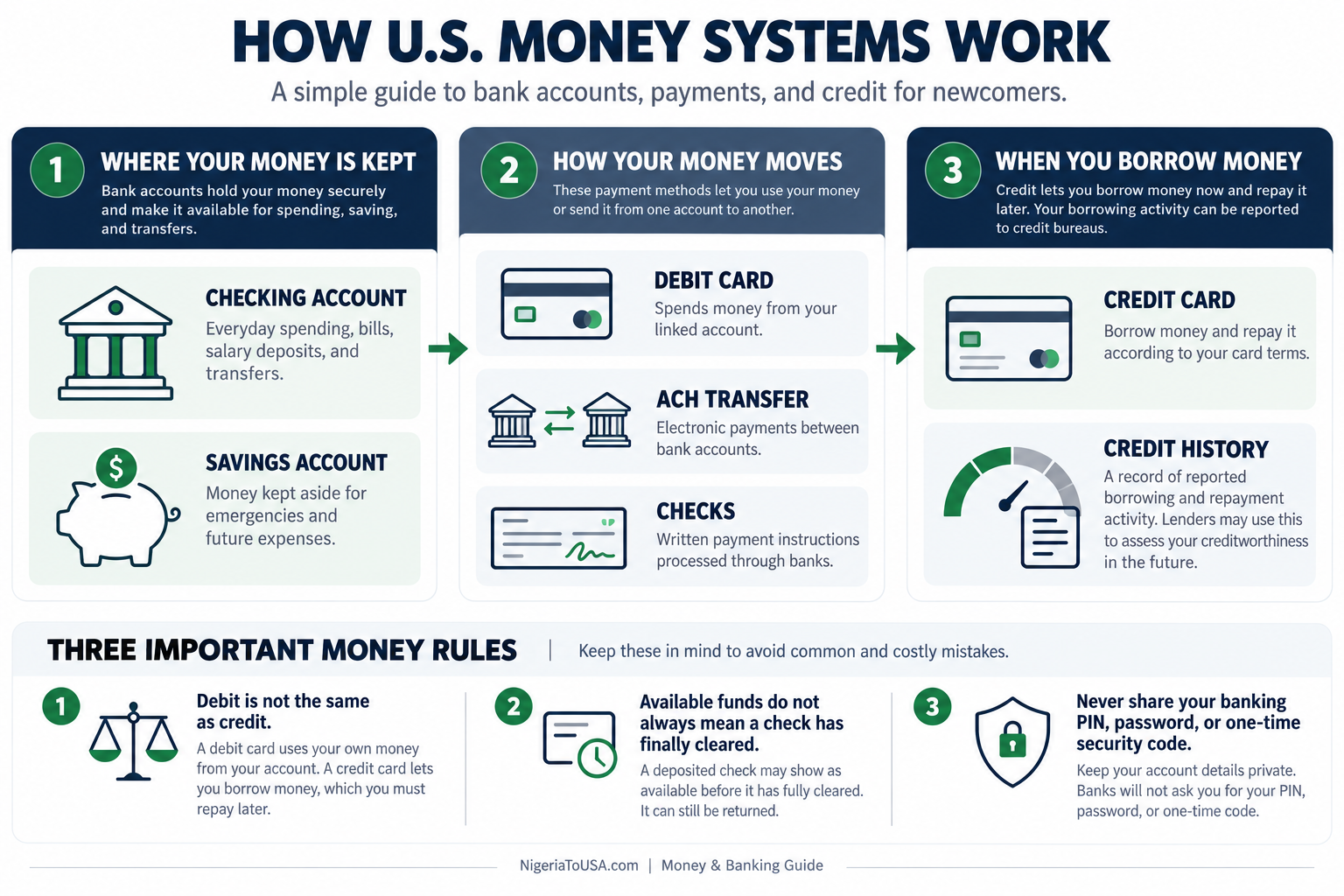
Click the image to open the full-size version for easier viewing.
Routing numbers, account numbers, ACH, and money transfers
U.S. banks use account numbers and routing numbers to identify where payments should go. These details are important for payroll, bill payments, and transfers.
Routing number versus account number
- Routing number: Identifies the financial institution for a particular payment system.
- Account number: Identifies your individual account at that institution.
Some institutions use different routing numbers for different types of transfers, such as ACH payments and wire transfers. Always confirm the correct instructions with your bank.
Common ways money moves in the U.S.
Electronic bank-to-bank payments commonly used for payroll, bills, and transfers. Timing, fees, and reversibility depend on the transaction and institution.
Bank transfers often used for larger or time-sensitive payments. They may involve significant fees and can be difficult to reverse.
Services that allow eligible users to send or receive money. Availability, protections, transfer limits, and account requirements vary.
Sending money between Nigeria and the United States
International transfers may involve exchange-rate margins, transfer fees, recipient-bank charges, processing times, and identity-verification requirements. Some services support only particular transfer directions, funding methods, or recipient account types.
Compare the total amount the recipient will receive, not just the advertised transfer fee. Use properly authorised services, check current rules, and verify recipient details carefully before sending money.
Practical tip
For a new recipient, consider verifying the payment instructions through a trusted channel before making a large transfer. A small test payment may help confirm details, but it does not eliminate fraud risk or guarantee that a later transfer can be recovered.
Checks, direct deposits, and bill payments
Although many U.S. payments are electronic, checks remain relevant for certain transactions, including refunds, rent, and payments from some organisations.
Paper checks
A check instructs a bank to pay money from the check writer’s account. You may deposit a check through a bank branch, ATM, or mobile banking app, depending on your bank’s services.
However, money appearing as available in your account does not necessarily mean a check has finally cleared or cannot later be returned.
Direct deposit
Direct deposit is a common way employers pay salaries directly into employees’ bank accounts. You may be asked for your account number, routing number, and account type.
Automatic bill payments
Recurring payments can be useful for rent, utilities, insurance, subscriptions, and other expenses. But you should monitor them carefully to avoid unexpected charges or insufficient funds.
Check fraud warning
If someone sends you a check and asks you to return part of the money, purchase gift cards, or forward funds to another person, treat it as a serious warning sign. Fraudulent checks can initially appear to have cleared before the bank discovers the problem.
Understanding U.S. credit history
Your bank balance and credit history are different things. You can have substantial savings but still have limited or no U.S. credit history when you first arrive.
Credit reports contain information about eligible borrowing accounts, payment history, and other reported financial activity. Credit scores are calculated using information in credit reports and can influence lending decisions.
Why credit history matters
- Applying for credit cards and loans
- Financing a vehicle
- Applying for a mortgage
- Some rental application screenings
- Other situations where legally permitted credit information is considered
Ways newcomers may begin building credit
- Consider a suitable starter or secured credit card if eligible.
- Make payments on time.
- Keep borrowing manageable relative to your financial circumstances.
- Review credit reports for inaccurate information.
- Avoid applying for numerous credit products without a clear need.
A secured credit card generally requires a refundable security deposit under the card’s terms, but not every secured card reports to all three major credit bureaus. Verify reporting practices and fees before applying.
You can learn more about U.S. credit reports through the Consumer Financial Protection Bureau (CFPB). The federally authorised website for requesting free credit reports is AnnualCreditReport.com. However, access to this website may be restricted from locations outside the United States. If you cannot access it, consult the CFPB for guidance on obtaining your credit report.
Bank fees and everyday budgeting
Bank fees can add up, especially during your first months in the United States. Understanding the fee structure before opening an account can help you keep more of your money.
Common fees to check
- Monthly maintenance fees: Regular charges for maintaining certain accounts.
- Out-of-network ATM fees: Charges that may apply when using an ATM outside your bank’s network.
- Overdraft fees: Charges that may apply when eligible transactions are paid despite insufficient funds, depending on the bank and your account settings.
- Wire transfer fees: Charges for certain domestic or international transfers.
- Foreign transaction fees: Charges that may apply to card purchases or transactions involving foreign currencies.
- Other service fees: Possible charges for replacement cards, certain paper statements, or specialised services.
A simple newcomer budget
Start by separating your expenses into three groups:
- Essential: Rent, food, transport, utilities, phone service, and necessary healthcare.
- Planned: School expenses, household items, professional certifications, and travel.
- Emergency: Unexpected medical costs, urgent travel, repairs, or temporary income interruptions.
Track recurring expenses, review your account activity, and consider setting up low-balance alerts. Remember that some card authorisations and pending transactions can affect how much money is actually available to spend.
Banking security and financial scams
Protecting your money involves more than choosing a reputable bank. Newcomers should learn how financial scams work and how to secure their accounts.
Essential banking security habits
- Use strong, unique passwords for banking accounts.
- Enable available multi-factor authentication.
- Never share your banking password, card PIN, or one-time verification code.
- Review transactions and enable account alerts.
- Contact your bank through its official app, website, or verified telephone number.
- Be cautious with unexpected payment requests, suspicious links, and urgent messages.
- Report lost cards or unauthorised transactions promptly.
- Protect your phone number because it may be used for banking verification and account recovery.
Common scams targeting newcomers
Messages pretending to come from your bank that ask you to click a link, share a code, or transfer money urgently.
Someone sends a fraudulent check and asks you to send part of the money elsewhere before the check is returned.
Fraudsters may demand deposits, application fees, or payments for fake accommodation or employment opportunities.
Security warning
If someone claims to be your bank and asks you to move money to a so-called safe account, do not follow those instructions. End the conversation and contact your bank independently using its official contact information.
Common money and banking mistakes to avoid
- Confusing debit and credit: A debit card usually spends your own funds, while a credit card involves borrowing.
- Choosing an account without checking fees: Monthly charges and ATM fees can reduce your balance.
- Assuming every banking app is a bank: Verify the institution, account structure, and applicable deposit protections.
- Ignoring pending transactions: Your displayed balance may not reflect every outstanding payment.
- Using a credit limit as income: Borrowed money must be repaid under the account’s terms.
- Sending money to unverified recipients: Some transfers may be difficult or impossible to reverse.
- Trusting an available check deposit too quickly: Funds availability does not guarantee that a check is genuine.
- Forgetting subscriptions: Recurring charges can continue even when you no longer use a service.
- Sharing sensitive security information: One-time codes and passwords should not be given to callers or strangers.
- Ignoring credit reports: Reviewing reports can help you identify inaccuracies or suspicious activity.
First-month financial priority
Establish reliable access to your funds, choose a suitable low-fee account, secure your banking credentials, understand how your bills are paid, and keep a realistic budget. Building credit and exploring more advanced financial products can come later.
Affiliate disclosure: Some links in this section may become affiliate links. If you make a purchase or sign up through an eligible link, NigeriaToUSA.com may earn a commission at no additional cost to you. Recommendations should be evaluated independently based on your needs.
Official sources and reliable financial information
Banking fees, eligibility requirements, deposit protection, transfer rules, and financial regulations can change. Verify current information directly with official agencies and your chosen financial institution.
- Consumer Financial Protection Bureau (CFPB) — Bank accounts
- Federal Deposit Insurance Corporation (FDIC) — Deposit insurance
- Consumer Financial Protection Bureau (CFPB) — Bank accounts, credit unions and deposit protection
- CFPB — Credit reports and scores
- AnnualCreditReport.com — Federally authorised credit reports
- CFPB — Fraud and scams
- U.S. Customs and Border Protection — Travelling with money
Important note
This guide provides general educational information for newcomers. It is not individual financial, tax, investment, immigration, or legal advice. Account eligibility, consumer protections, and applicable rules depend on your circumstances and the financial product involved.